🏛️ Property History • Genealogy • Historical Investigation
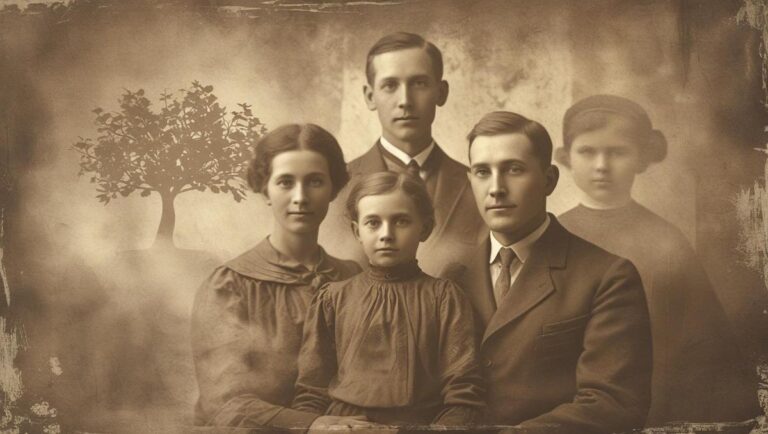
Some spirits don’t haunt houses; they haunt names, memories, and heirlooms. They linger in lullabies passed down, in dreams that repeat, in patterns that seem to skip generations but never truly vanish. This is often a sign of a cursed bloodline.
In my work as a genealogist and haunted history researcher, I’ve come to believe that some hauntings run deeper than cold spots and creaking floors. These are the hauntings of the bloodline where family stories, griefs, and unresolved legacies echo across generations. Such occurrences suggest the presence of a cursed bloodline.
Folklorists have long told tales of cursed families or “bad blood,” but this isn’t always about evil. Sometimes it’s about unfinished business, collective memory, or the deep imprint of trauma.
A haunted bloodline may look like:
In the Appalachian mountains, this might be described as “haints in the holler.” Further, in Celtic tradition, it’s the banshee who wails before a death in the family. In African diasporic spirituality, it’s common to recognize ancestral spirits that walk with you. However, these traditions may sound different, but they all recognize the same thing: some spirits are considered family members and may point to a cursed bloodline.
As a genealogist, I often trace lines through dusty deeds and church records. Sometimes, its the silence between the records that speak the loudest. This silence is like the hidden whispers of a cursed bloodline.
A few years ago, I was researching a family whose women had all lost children at the same age. The records offered no apparent reason, but in the oral histories, there was a whispered story of a grandmother who had been “cursed” after defying her preacher husband. Coincidence? Maybe. However, when the family acknowledged her story, the pattern broke.
I’ve come to trust that our ancestors want their stories told, especially the ones who were silenced. Recognizing a cursed bloodline may be the first step to healing.
Modern research is catching up with folklore. Psychologist Rachel Yehuda has studied how trauma, particularly from war and persecution, can be passed down genetically through epigenetic markers. As a result, this may mean that the fear or grief your ancestor felt may still be reflected in your DNA.
Family constellations therapy (a method developed by Bert Hellinger) takes this further, suggesting that unresolved pain in a family system will continue to manifest until it’s witnessed, honored, and healed.
Even Carl Jung, the father of analytical psychology, described the “collective unconscious” as a place where ancestral memory dwells and from which it sometimes surfaces in dreams, compulsions, or spiritual callings.
Healing a haunted bloodline doesn’t always mean performing exorcisms or smudging the house. Sometimes it starts by acknowledging the patterns of a cursed bloodline:
– Turning the pain into a legacy
– Telling the untold stories
– Researching the forgotten ancestor
– Creating space for grief, ritual, or forgiveness
Do you feel your family has its haunting? Have you uncovered patterns that seem too strange to be a coincidence? Perhaps it’s time to explore the concept of a cursed bloodline.
I’m inviting you to walk with me into this topic one post at a time. In future posts, we’ll explore:
Furthermore, if you’ve got a story? I’d love to hear it.
Sometimes the dead don’t just want to be remembered. They want to be understood, especially in the context of a cursed bloodline.
Sources & inspiration:
© 2025 PennsStory Genealogy All Rights Reserved Kimberly Chaffee
We use cookies to improve your experience on our site. By using our site, you consent to cookies.
Manage your cookie preferences below:
Essential cookies enable basic functions and are necessary for the proper function of the website.
These cookies are needed for adding comments on this website.
Statistics cookies collect information anonymously. This information helps us understand how visitors use our website.
Google Analytics is a powerful tool that tracks and analyzes website traffic for informed marketing decisions.
Service URL: policies.google.com (opens in a new window)
SourceBuster is used by WooCommerce for order attribution based on user source.