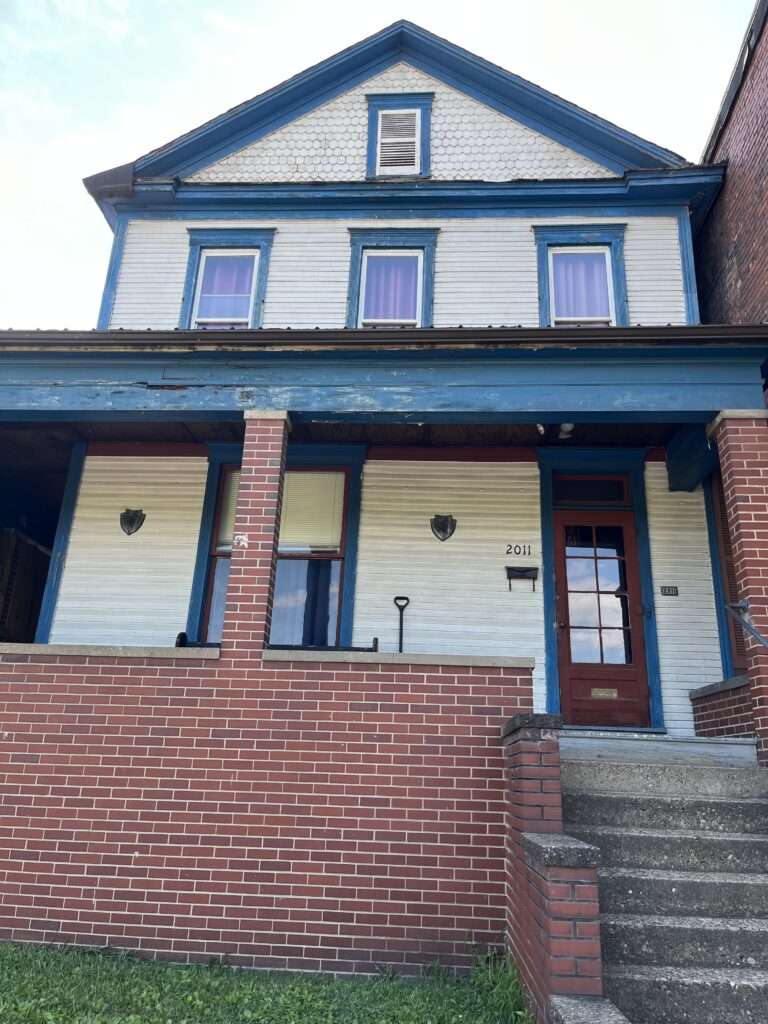
Historic homes often hold stories that are not immediately visible. The Ross House in Bellaire, Ohio is one such property. At first glance, it appears to be simply another nineteenth-century residence. However, the records connected to the house reveal a much deeper history.
Two types of sources are especially valuable when researching a property like this: deed records and census records. Together, these documents allow researchers to trace ownership, identify the families who lived there, and understand how the house fit into the community over time.
By following the paper trail left behind in Belmont County records, it becomes possible to reconstruct the story of the Ross House and the people connected to it.
What The Ross House Deed Records Tell Us
Deed records tell us who owned the Ross house (chain of title) through the years and when ownership changed. Below is a list of deed owners based on records from Belmont County, Ohio.
- Harry and Ora L. Weeks (Grantor) to J. Keith Lafferty (Grantee) 13 July 1936.
- J. Keith Lafferty (Grantor) to Earl & Elizabeth Leiffer (Grantee) 21 Oct 1937.
- Earl & Elizabeth Leiffer (Grantor) to Marie G. Getrost (Grantee) 24 May 1948.
- Marie G. Getrost (Grantor) to Charles B. & Dolly Ross (Grantee) 24 April 1990.
- Dolly Ross (Grantor) to Charles R. Ross 6 April 2023.
We can learn from these records who held the property at 2011 Belmont St. However, there is another source to tell us who these people were and what jobs they had. More importantly, we can discover who resided in the house before 1936.
The house was built sometime after 1899, and we know this because it appears on the Sanborn Maps in June of 1900 as 2009 1/2.
Sanborn Fire Map 1900 Bellaire Ohio

By 1915, the house had been renumbered to 2011 Belmont Street.
Census Records
As we delve deeper into the history of the Ross House, the census records provide a vivid glimpse into the lives of its inhabitants. Each entry reveals the occupations and family dynamics of those who called this house home, painting a picture of resilience and community.
From the early 1900s, we find skilled laborers and budding entrepreneurs. Their stories are intertwined with the growth of Bellaire itself. This narrative, woven together by both deed and census records, brings the Ross House to life, transforming it from a mere structure into a vessel of rich personal histories and local heritage.
Ora Weeks and Frank Fralinger were married in 1892, resulting in the birth of twin sons, John Keith and Jacob Kenneth Fralinger. However, the 1900 census indicates that Ora had relocated and married Harry Weeks, a glassblower residing in Bellaire. In the census, the boys were listed by their middle names rather than their first names.
We also learn from the census that John, Mary, and Minnie Lafferty ages 57, 58, and 32 are living in the Ross house. This family includes the parents of Ora and her sister Minnie.
The Lafferty family played a crucial role in the early social fabric of Bellaire. They contributed to community events and local gatherings. As the years progressed, the house became a gathering place for relatives and friends, echoing with laughter and stories of times gone by.
The changing dynamics of the household reflected broader trends of the era, including shifts in economic opportunities and family structures. Neighbors would often drop by, creating a sense of camaraderie that defined the tight-knit community.
Eventually, Harry and Ora sold the house to John Keith, Ora’s son, and they left for California. He owned the house for about a year before selling it.
Chinchilla Fur Business
The home served as a business for a time, raising chinchillas that Marie Getrost and her husband Frederick sold for the fur industry. They were kept in an upstairs room.
Frederick’s draft card for World War II indicates that he was a fire truck driver. They did not move into the Ross house until 1948.
For a period, the residence served as a business where Marie Getrost and her husband Frederick bred and sold chinchillas for the fur trade. The animals were housed in an upstairs room. Frederick’s draft card from World War II indicates that he worked as a fire truck driver.
The couple did not relocate to the Ross house until 1948. After settling in, the Getrosts expanded their chinchilla business, attracting interest from fur traders across the region.
They built a reputation for producing high-quality pelts, establishing a loyal customer base. As the fur industry’s popularity grew, so did their operation, leading to renovations in the home to accommodate more chinchillas.
However, by the late 1950s, shifting attitudes toward fur and animal rights began to impact their business. Eventually, the Getrosts decided to close the chinchilla breeding operation and repurpose the space for family use.
The home was later bought in 1990 by Charles Ross, whose family owned the furniture store next to the house. Before the home was opened for paranormal tours and investigations, it was used for entertainment purposes featuring escape rooms.